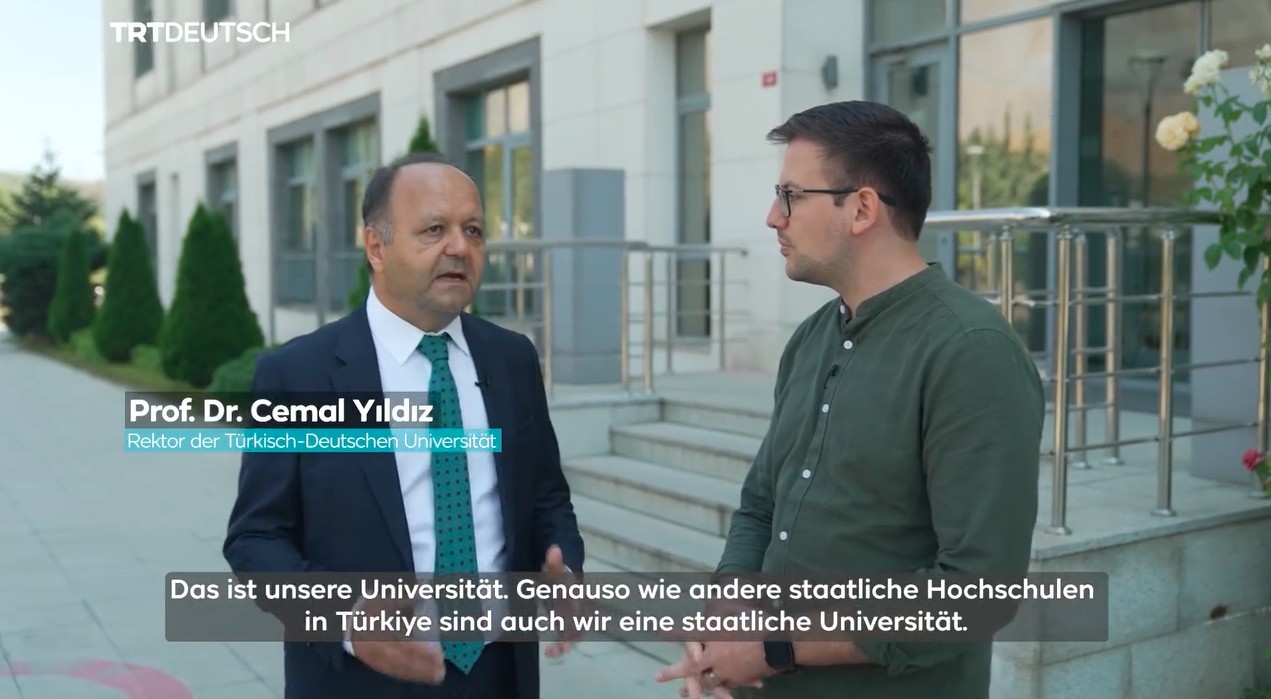
TRT Deutsch Had an Interview with Our Rector, Prof. Dr. Cemal Yıldız
Turkish-German University: A “Strategic Bridge” Between Türkiye and Germany
The Turkish-German University aims to further deepen cooperation between Türkiye and Germany. Rector Cemal Yıldız spoke to TRT Deutsch about new degree programmes, artificial intelligence, international partnerships and the university’s future.
The Turkish-German University (TGU) in Istanbul sees itself as a link between Türkiye and Germany. Rector Professor Cemal Yıldız views the institution not only as a joint educational project, but also as a strategic platform for scientific, economic and social relations between the two countries. “Our mission is to contribute to scientific, economic and cultural cooperation between Türkiye and Germany,” Yıldız told TRT Deutsch.
The university brings together two different higher education systems while creating a model in which academic knowledge meets the needs of industry, technology and society. Since its establishment, TGU has worked with the German Academic Exchange Service (DAAD) and 39 partner universities in Germany. Dual-degree programmes, student and academic exchanges, and joint research projects continue to strengthen this cooperation. The university thus serves as a bridge that extends beyond traditional diplomacy.
Major potential in AI, digitalisation and industry partnerships
According to Yıldız, TGU’s greatest potential lies in combining two distinct higher education traditions. This gives students the opportunity to explore different academic approaches and prepare for an international working environment.
The rector announced plans to further expand the university’s academic infrastructure, international partnerships and institutional capacity in the coming years. “Artificial intelligence, digital transformation, Industry 4.0, practice-oriented education and university-industry cooperation, in particular, offer enormous potential,” Yıldız said.
Technological change is no longer limited to technical disciplines. Artificial intelligence, data science, green technologies and modern production systems are transforming nearly every field. “Every discipline, from law and economics to cultural studies, communication and administrative sciences, must prepare for this new era,” Yıldız said. TGU is therefore continuing to develop its degree programmes while strengthening interdisciplinary courses, research centres and practice-oriented projects.
The university also considers itself well positioned academically. Alongside their professional qualifications, Yıldız said, students stand out for their German and English language skills, international working culture and interdisciplinary perspective. As a concrete indicator, he cited Kariyer.net’s University Index on Employer Preferences, in which TGU ranks fourth across Türkiye. “For us, however, the most important benchmark is the contribution our graduates make to science, economic development and society in Türkiye and Germany,” the rector said.
Opportunities for young people from Germany
TGU also aims to become more attractive to young people from Germany. Applicants holding an Abitur with the required grades can apply through the university’s international student quotas. The university’s model offers particular opportunities for young people of Turkish heritage whose first language is German.
They can further develop the academic knowledge they acquired in Germany while studying in an international environment in Türkiye. “Our multilingual education and international academic environment provide an important advantage for these students,” Yıldız said.
At the same time, the university is expanding its academic portfolio. The new German Language and Literature and Psychology programmes are intended to strengthen its multilingual and intercultural focus.
The German Language and Literature programme was developed in cooperation with Ludwig Maximilian University of Munich (LMU). It aims to provide students with advanced proficiency in German and Turkish and enable them to examine linguistic and cultural phenomena from a comparative perspective. Graduates will be prepared both for further academic study and for careers in education, publishing, media and communications.
The Psychology programme was established through an academic partnership with Heidelberg University. Around 30 percent of classes are taught in German. The four-year bachelor’s programme combines theoretical foundations with scientific research and practical skills. “We want to train psychologists who think critically and analytically and are committed to ethical principles,” Yıldız said. Through a curriculum coordinated with Heidelberg University, students are also expected to develop a strong command of professional terminology in both German and English.
Further programmes are either planned or under consideration. The decisive factor will be whether they expand the university’s international cooperation network and extend its interdisciplinary and intercultural approach to additional fields.
Mevlüde Genç as a symbol of coexistence
Yıldız attaches particular importance to the university library being named after Mevlüde Genç. Despite the immense personal suffering she endured, Genç consistently placed humanity, tolerance and social coexistence at the forefront.
“The fact that her name lives on in our university library is deeply connected to the values of intercultural dialogue, mutual understanding and coexistence that our university represents,” Yıldız said. The decision also demonstrates that TGU considers not only academic achievement but also universal human values to be an integral part of its identity.
“Shaping the future together”
In the long term, Yıldız envisions the Turkish-German University developing into a strategic centre where Türkiye and Germany conduct joint research and shape the future together.
“Our goal is to become a university with strong research capacity, robust international partnerships and graduates who are in demand worldwide,” Yıldız said. Students should be prepared not only for today’s professions but also for the demands of the future. International partnerships, a strong academic structure, research infrastructure and multilingual education form the foundation of this vision.
For Yıldız, the task also has a personal dimension. Throughout his professional career, he has gained extensive knowledge of Turkish-German educational relations and worked directly in this field. His current role at TGU enables him to apply this experience at an institutional level.
“For me, the Turkish-German University is not merely a higher education institution,” Yıldız said. Rather, it is “a unique academic space where different cultures enrich one another, produce knowledge together and shape the future together.”
As evidence of the model’s success to date, the rector pointed to graduates working in academia and business in both Türkiye and Germany. Feedback from companies has also been positive. Graduates are particularly praised for their ability to work independently, solve problems and adapt to international working cultures. The university, along with several of its faculties and degree programmes, has also received accreditation. According to Yıldız, these developments demonstrate “that we have established the right educational model.”
Source: https://www.trtdeutsch.com/article/0804e3324945