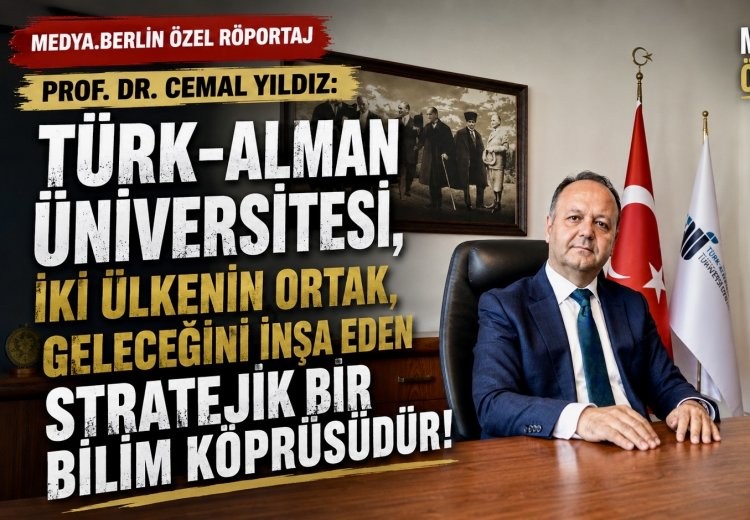
Rector Prof. Dr. Cemal Yıldız Answers Questions About Our University
Prof. Dr. Cemal Yıldız: “The Turkish-German University Is a Strategic Bridge of Science Building a Shared Future for the Two Countries”
Relations between Türkiye and Germany are not limited to the diplomatic and economic spheres. Partnerships in science, education, and technology also stand out as some of the most enduring ties between the two countries. As one of the most significant institutions embodying this partnership, the Turkish-German University attracts attention with its international education model, dual-degree opportunities, and the high employability rate of its graduates.
Mustafa Ekşi, Editor-in-Chief of Medya.Berlin, spoke with Prof. Dr. Cemal Yıldız, Rector of the Turkish-German University, about the University today and its vision for the future. The exclusive interview addressed a wide range of important topics, from artificial intelligence and digital transformation to cooperation with industry and the opportunities available to young Turkish people living in Germany who hold an Abitur qualification.
One of the Strongest Examples of Science Diplomacy
At a time when global competition is increasingly shaped by the production of knowledge, universities are no longer regarded solely as institutions of education. They are also seen as strategic centers that influence countries’ science diplomacy, economic development, and international competitiveness.
The Turkish-German University, established as a joint higher education project between Türkiye and Germany, is an important example of this approach. Bringing two distinct academic traditions together under one roof, the University aims not only to educate graduates capable of meeting the needs of the business world, but also to strengthen long-term scientific and technological cooperation between the two countries.
Today, the fact that its graduates work across a broad spectrum of organizations in Türkiye and Germany—from public institutions and international companies to research centers and technology start-ups—demonstrates the success of this model.
So, how is the Turkish-German University preparing for the future?
What will the University’s new vision look like in the age of artificial intelligence?
How will cooperation with industry be further developed?
And what opportunities are available to the thousands of young Turkish people living in Germany who hold an Abitur qualification?
All these questions were put to Prof. Dr. Cemal Yıldız, Rector of the Turkish-German University.
“Our Graduates Are the Most Tangible Outcome of Academic Cooperation Between the Two Countries”
Mustafa Ekşi: Dear Mr. Rector, first of all, thank you for taking the time to speak with us. I would like to begin with graduate employment.
Can we regard the Turkish-German University’s success in graduate employment as one of the most tangible outcomes of academic and economic cooperation between Türkiye and Germany?
Prof. Dr. Cemal Yıldız: First of all, I would like to thank you for your interest in our university.
It is a great pleasure to have this opportunity to speak with you.
I can answer your question with a confident “yes.”
I consider the success of Turkish-German University graduates in the labor market as one of the most tangible results of the longstanding academic and economic cooperation between Türkiye and Germany.
Our university is not simply an institution that brings together the higher education systems of the two countries.
It also represents a distinctive model of cooperation in which academic knowledge meets industry, technology, and the needs of society.
Since our establishment, our cooperation with the German Academic Exchange Service (DAAD) and our 39 partner universities in Germany has enabled our students to experience the strengths of two different academic traditions within a single educational journey.
Dual-degree opportunities, student exchange programs, and joint scientific research are among the most important components of this model.
The success our graduates achieve today therefore clearly demonstrates that Türkiye-Germany cooperation is not merely a theoretical concept, but a successful model that produces measurable and tangible results.
“We educate graduates who are sought after by employers”
Mustafa Ekşi: What are the most important advantages this educational model offers graduates?
Prof. Dr. Cemal Yıldız: Our graduates leave the University with more than a strong academic foundation.
Their proficiency in German and English, ability to adapt to international working cultures, and capacity for interdisciplinary thinking also give them a significant advantage in the professional world.
A clear indicator of this is that Turkish-German University ranks fourth nationwide in the 'University Index of Employers' Preference' prepared by Kariyer.net.
For us, however, success is not simply a matter of employment rates.
What truly matters is the contribution our graduates make to scientific advancement, economic development, and social progress in Türkiye and Germany.
We believe that this is far more valuable.
“We do not measure success solely by employment figures”
Mustafa Ekşi: Which areas will shape the Turkish-German University’s core vision in the coming period?
Prof. Dr. Cemal Yıldız: Our ultimate goal is to further elevate the strong spirit of collaboration that lies at the core of our foundation.
We do not assess our success solely in terms of our graduates’ employment rates.
The scientific knowledge we produce through cooperation between the two countries, the highly qualified human capital we cultivate, and the solutions we offer to the challenges of the future are of far greater importance to us.
The Turkish-German University will continue to pursue its work in line with this vision in the years ahead.
“Artificial intelligence is no longer exclusive to engineering; it has become a subject for all disciplines”
As higher education institutions around the world undergo a process of transformation centered on artificial intelligence and digitalization, the Turkish-German University is among the pioneering institutions preparing for this change.
According to Rector Prof. Dr. Cemal Yıldız, the university of the future cannot simply be an educational institution that imparts technical knowledge. It must become a multidisciplinary center of knowledge capable of addressing technology in its ethical, legal, and social dimensions.
Mustafa Ekşi: Professor Yıldız, artificial intelligence and digital transformation are among the most important issues on the global agenda today. Where does the Turkish-German University stand in this transformation?
Prof. Dr. Cemal Yıldız: Today, artificial intelligence, data science, digital transformation, green technologies, and advanced manufacturing systems are reshaping virtually every sector.
This transformation is no longer relevant only to engineering disciplines.
Every discipline—from law and economics to communication sciences and cultural studies—must prepare for this new era.
As a university, we therefore continuously update our academic programs in line with this understanding.
We are enhancing our interdisciplinary education models, strengthening our research centers, and placing a greater emphasis on application-oriented studies.
This is because, in the world of the future, producing knowledge will increasingly depend on our ability to bring different disciplines together.
“We are breaking down the barriers between university and industry”
One of the most important objectives of higher education institutions in Türkiye is to transform theoretical knowledge directly into practical applications and production.
Drawing on Germany’s practice-oriented educational model, the Turkish-German University aims to bring students into contact with industry throughout their education.
Mustafa Ekşi: How do you plan to further develop cooperation with industry?
Prof. Dr. Cemal Yıldız: We are making university-industry cooperation a natural part of our students’ educational experience.
We aim to undertake more joint projects with companies in both Türkiye and Germany.
We will also expand our internship programs, practice-oriented training opportunities, and mentoring systems.
Our objective is not merely to prepare students for existing professions.
We want them to become individuals capable of creating new areas of employment, thinking entrepreneurially, and helping shape technological transformation.
This is precisely the kind of human capital needed in the age of Industry 4.0.
Our Research Laboratories Application and Research Center along with our Digital Transformation Application and Research Center are also carrying out important work in pursuit of this objective.
Producing knowledge matters, but so does managing technology responsibly
According to Rector Cemal Yıldız, one of the most important debates of the future will not concern the development of new technologies alone.
Ensuring that the ethical, legal, and social implications of these technologies are properly managed will also become one of the fundamental responsibilities of universities.
Mustafa Ekşi: What kind of vision do you put forward in the field of research?
Prof. Dr. Cemal Yıldız: Our goal is to develop the Turkish-German University into more than an institution that provides education.
We want it to become an international center for science and innovation where researchers, entrepreneurs, and representatives of industry from both countries come together.
To this end, we are strengthening our laboratories.
We are expanding our research projects.
We are developing new programs.
In particular, we attach great importance to integrating artificial intelligence into our processes in a safe, ethical, and human-centered manner.
Producing technology is, of course, extremely important.
However, managing its impact on society responsibly is equally important.
This will be one of the most important responsibilities universities assume in the years ahead.
“We offer an important opportunity for young Turkish people with an Abitur qualification”
The Turkish-German University offers an internationally oriented educational alternative not only for students in Türkiye but also for thousands of young Turkish people living in Germany. Students who hold an Abitur qualification, in particular, have the opportunity to study within the joint higher education model established by Türkiye and Germany.
Rector Prof. Dr. Cemal Yıldız encouraged young Turkish people in Germany to take advantage of these opportunities.
Mustafa Ekşi: Professor Yıldız, what message would you like to give to young Turkish people living in Germany who hold an Abitur qualification?
Prof. Dr. Cemal Yıldız: The Turkish-German University offers a genuinely valuable opportunity for young people living in Germany.
Applicants who hold an Abitur qualification and meet the required grade criteria can apply through the Student Information System under the international student quota.
This gives them the opportunity to further develop the academic foundation they have acquired in Germany here in Türkiye.
At the same time, they have the opportunity to shape their careers in an international educational environment within the joint higher education model of the two countries.
In this respect, the Turkish-German University continues to serve as a strong educational bridge between Türkiye and Germany.
“We are preparing our youth not just for today's world, but for the world of the future.”
At the end of the interview, Rector Prof. Dr. Cemal Yıldız addressed young people directly while also summarizing the University’s fundamental objective.
Mustafa Ekşi: Finally, what message would you like to give to young people?
Prof. Dr. Cemal Yıldız: The Turkish-German University is a strategic institution of higher education through which Türkiye and Germany think together, produce together, and build the future together.
We are not preparing young people solely for the professions of today.
Our true objective is to prepare them for the world of the future.
Through our international academic partnerships, strong academic staff, research infrastructure, and multilingual education model, we equip our students with the knowledge and skills they need to compete on a global scale.
Every step we take at our campus in Beykoz is, in fact, an investment in the shared future of Türkiye and Germany.
The achievements of our graduates today are only the beginning of this vision.
I am confident that we will take this vision much further in the years ahead.
I would like to take this opportunity to thank all our academics, administrative staff, and students for their contributions, and I invite young people and their families to discover the Turkish-German University and the opportunities it offers.
Since its establishment, the Turkish-German University has stood out as one of the most important higher education projects to have transformed academic cooperation between the two countries into an institutional framework.
The statements of Rector Prof. Dr. Cemal Yıldız demonstrate that the University is adopting a new vision that extends beyond the conventional role of an educational institution, with a growing emphasis on science diplomacy, technological innovation, and international research capacity.
The particular emphasis placed on artificial intelligence, digital transformation, Industry 4.0, practice-oriented education, and university-industry cooperation reflects a strategic approach to the future of higher education.
The invitation aimed at Turkish youth with an Abitur qualification living in Germany does not merely offer individual education opportunities; it is also regarded as part of a long-term vision that will contribute to strengthening the qualified human resources between the two countries.
At a time when competition in education, science, and technology is intensifying across Europe, the Turkish-German University’s international partnership model and bilingual educational structure offer its graduates significant advantages in a global context.
MEDYA.BERLIN NOTE
The statements of Prof. Dr. Cemal Yıldız indicate that the Turkish-German University aims to develop a new-generation university model that moves beyond a conventional higher education approach focused solely on academic achievement, placing research, technological development, cooperation with industry, and international competitiveness at its core.
In particular, the ethical use of artificial intelligence, the development of human capital equipped for Industry 4.0, and the expansion of joint research capacity with Germany stand out as key elements of the University’s strategic roadmap for the coming years.
10 KEY MESSAGES
The Turkish-German University is one of the most tangible examples of academic cooperation between Türkiye and Germany.
Graduates gain not just a degree, but an international work culture.
A strong academic network has been established through the DAAD and 39 German partner universities.
Artificial intelligence and digital transformation are at the heart of the University’s new strategy.
University-industry cooperation will be further expanded.
The University aims to cultivate entrepreneurial human capital equipped for the age of Industry 4.0.
The ethical and safe use of artificial intelligence will be among its priority research areas.
Young Turkish people with an Abitur qualification are offered an international educational opportunity.
The Turkish-German University continues to play an important role in science diplomacy between the two countries.
The goal is to cultivate graduates who will shape not just today's world, but the world of the future.
Source: https://medyaberlin.com/prof-dr-cemal-yildiz-turk-alman-universitesi-iki-ulkenin-ortak-gelecegini-insa-eden-stratejik-bir-bilim-koprusudur